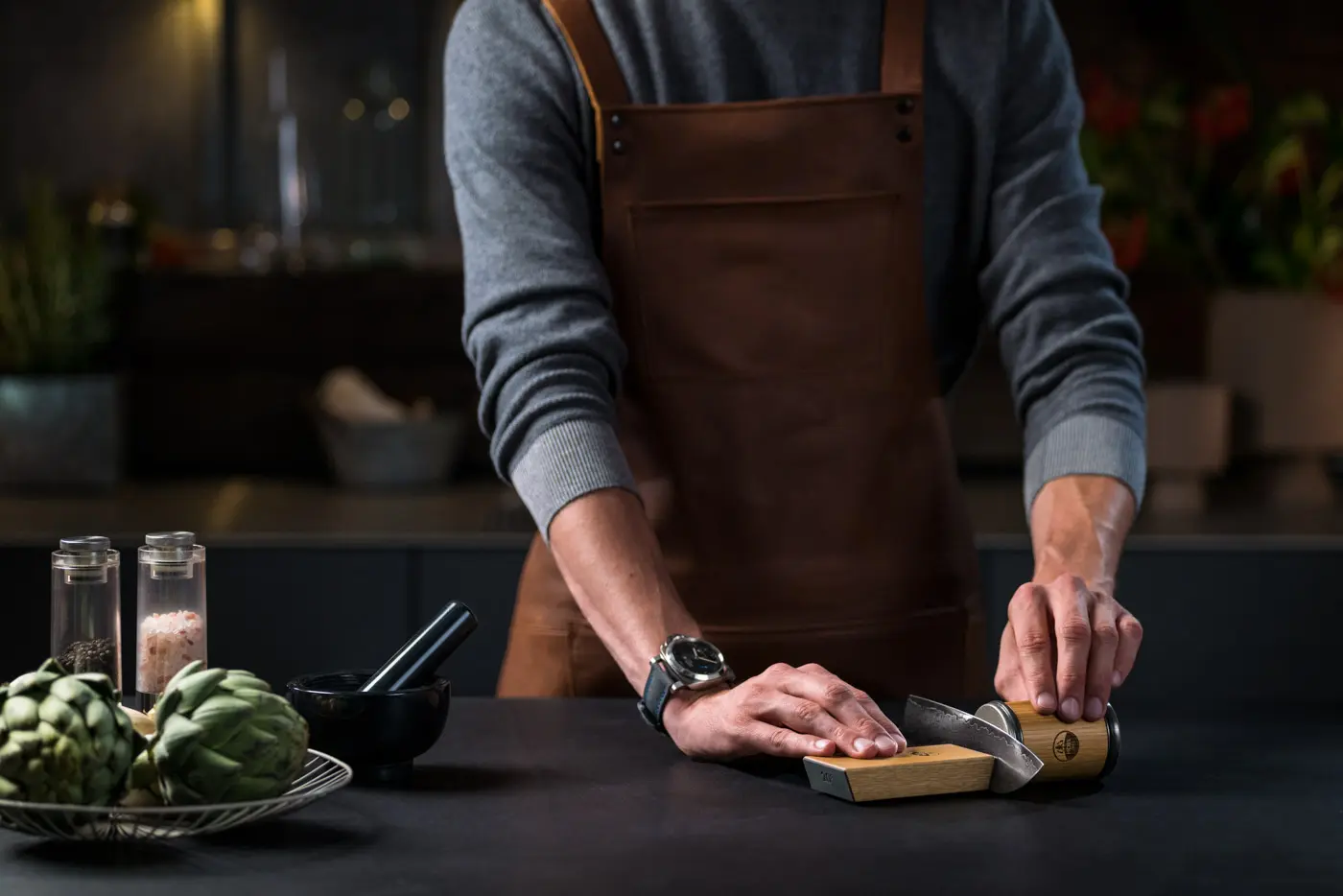
The art of sharpening blades and knives is a practice as old as the use of these tools themselves.
A sharp edge is not only synonymous with cutting efficiency and precision, but also with safety, as a sharp blade requires less force to perform a job, reducing the risk of slips and accidents.
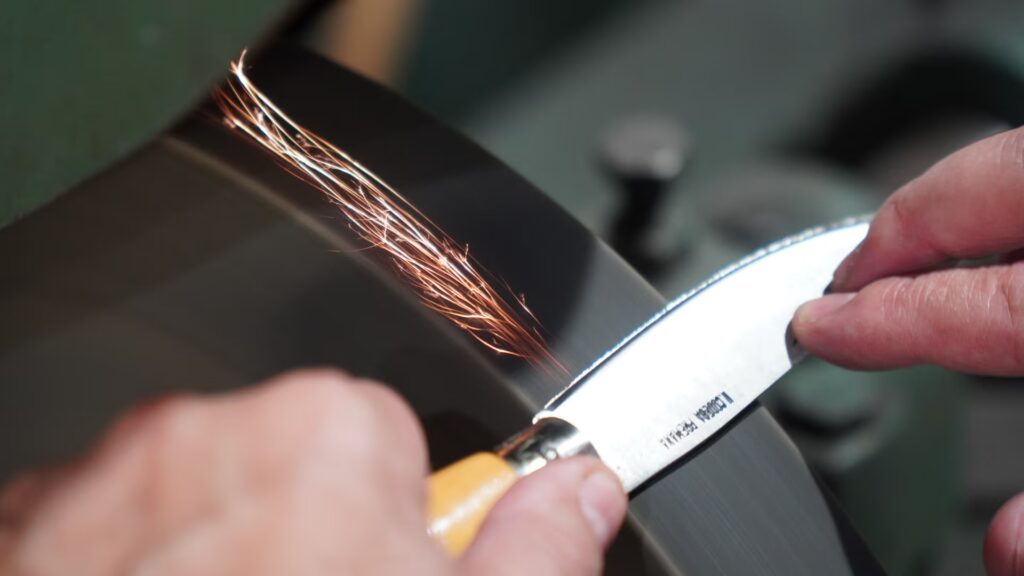
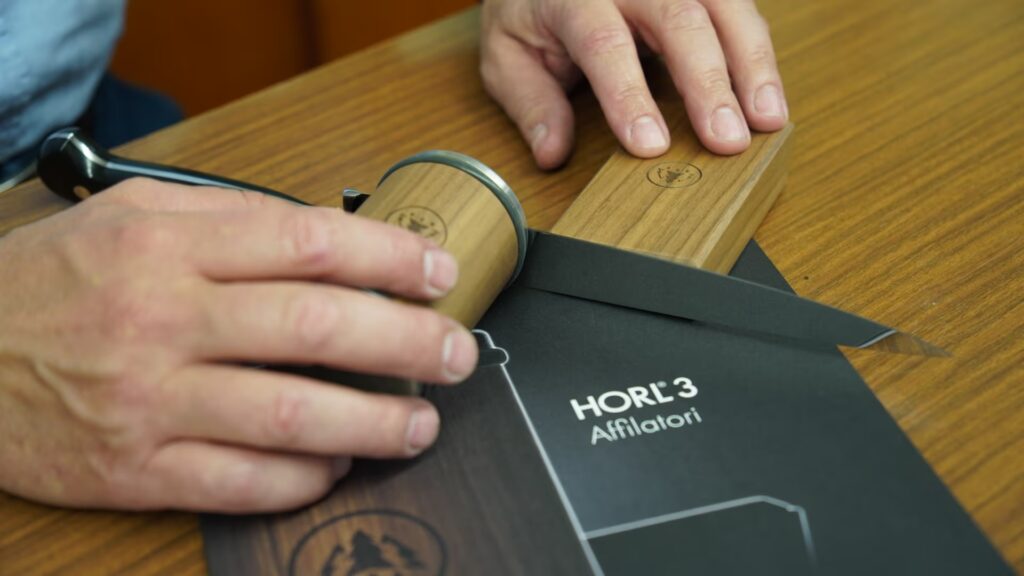
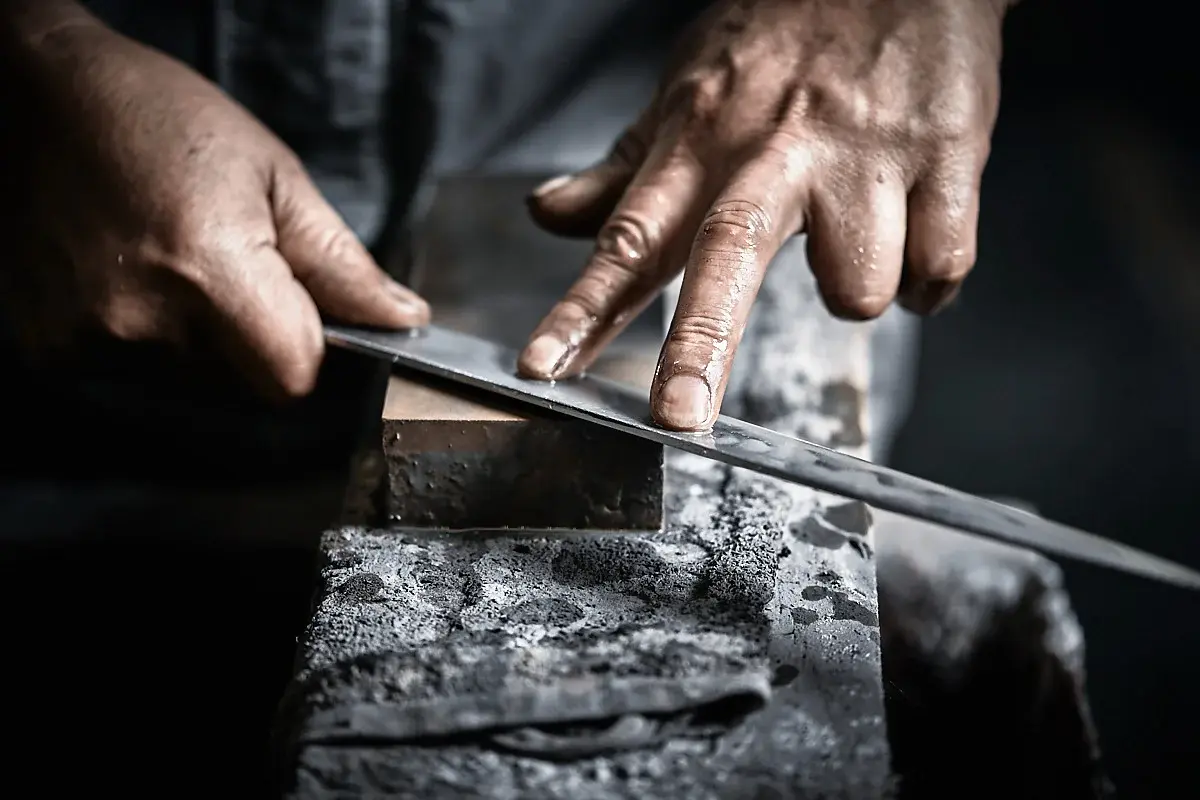
Manual knife sharpening is an art that requires patience, precision and a good deal of manual dexterity.
In contrast to mechanical methods, hand sharpening allows meticulous control over the angle and pressure exerted on the blade, allowing for an extremely sharp edge customized to the specific needs of the knife.
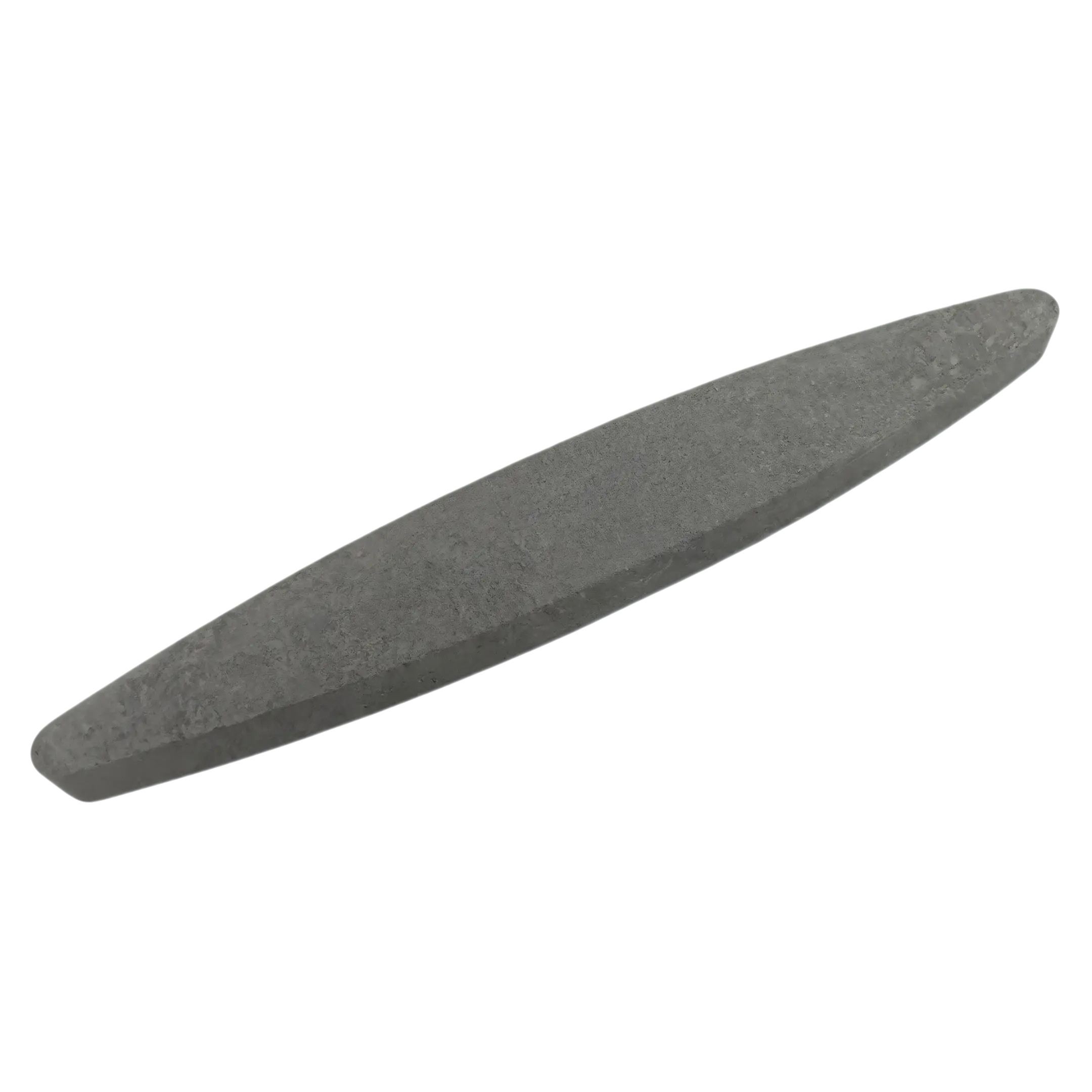
The protagonist of this process is the abrasive stone
These stones are available in different grits, indicated by a number that specifies their roughness:
Coarse grit (e.g., 100-400): used to repair significant damage to the wire, such as chipping or reshaping a very blunt corner.
Medium grit (e.g., 800-1200): used to sharpen the edge after using a coarse-grained stone, removing the most obvious scratches and beginning to define the cutting edge.
Fine grit (e.g., 3000-8000): used to further refine the edge, making it extremely sharp and to polish the bevel.
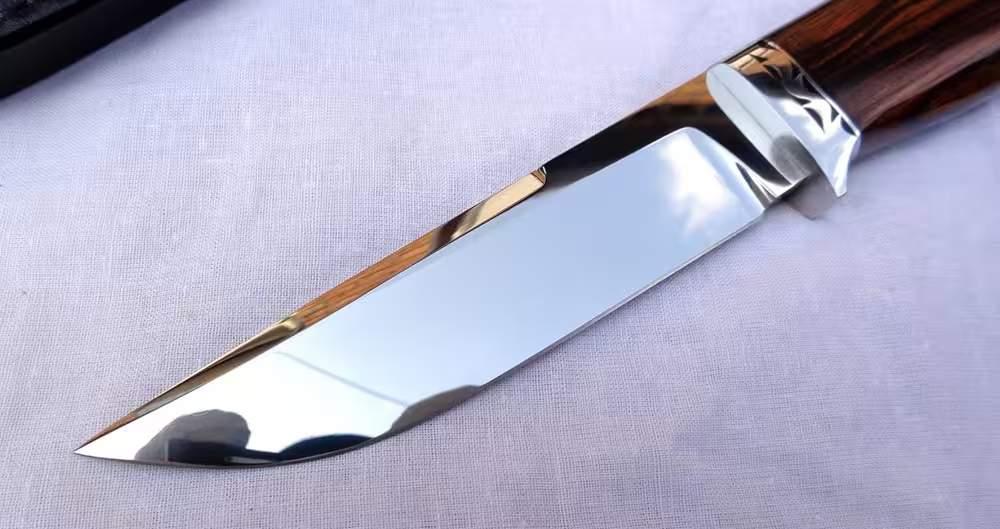
Extra-fine grit (over 8000): used for a final polish, resulting in a "razor-like" edge.
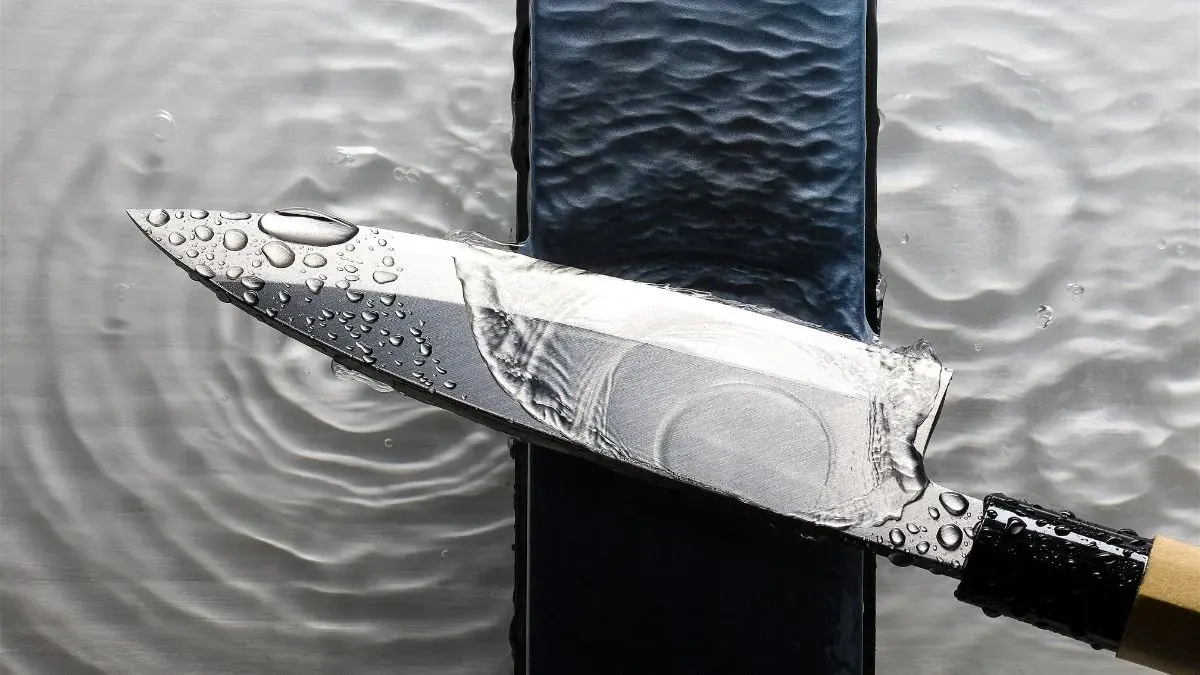
In addition to stones, the use of a lubricant, usually water or oil, is essential; it performs several crucial functions:
Reduces friction
Allowing the blade to slide more easily over the stone.
Dissipates heat
Avoiding overheating of the blade that could alter its tempering.
Wards off metal particles
Keeping the stone surface clean and preventing pore clogging.
The manual sharpening process typically follows these steps:
1. Preparation:
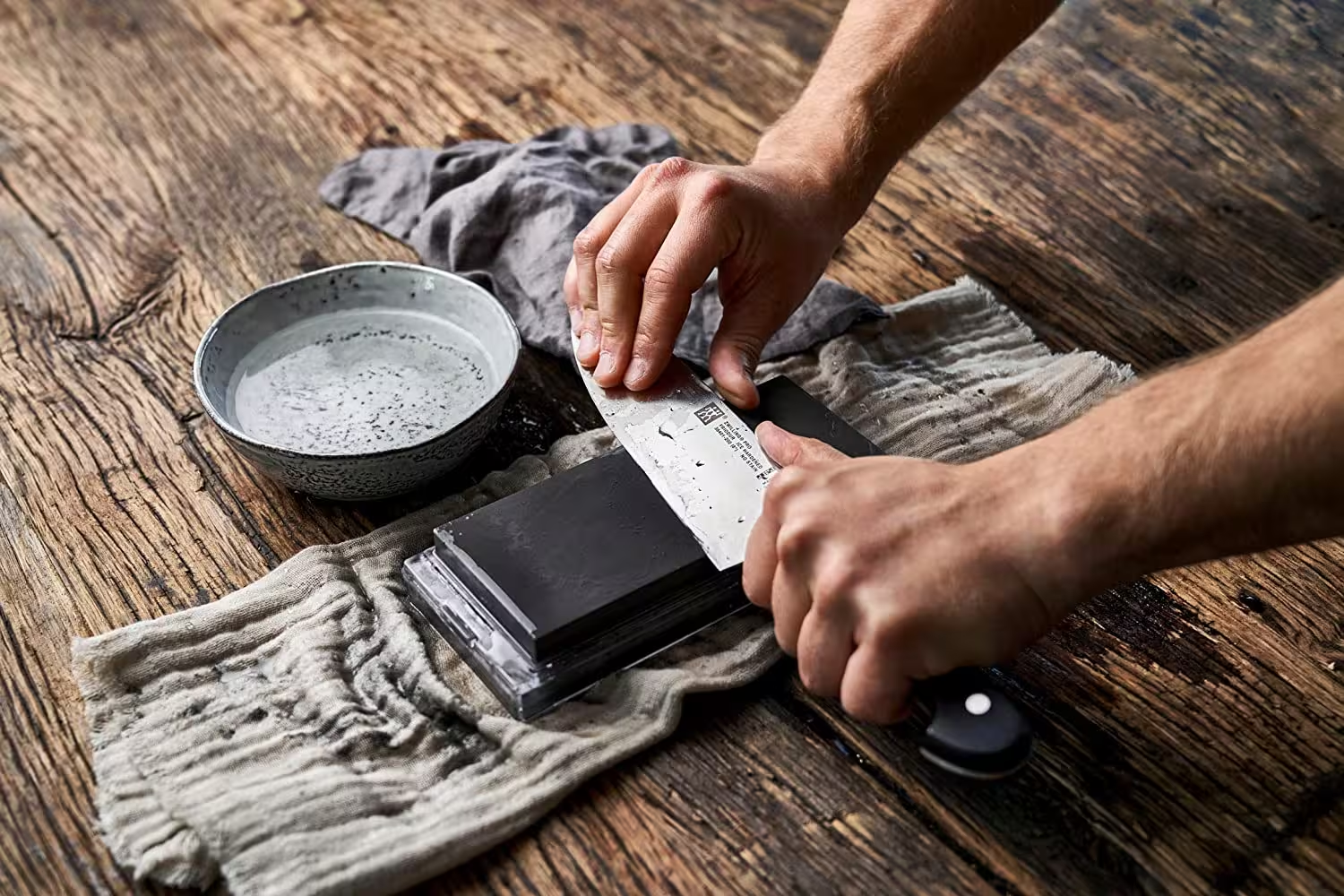
the abrasive stone is immersed in water for a few minutes (in the case of water stones) or sprinkled with oil (in the case of oil stones). It is important that the stone is well lubricated throughout the process.
2. Angle setting:
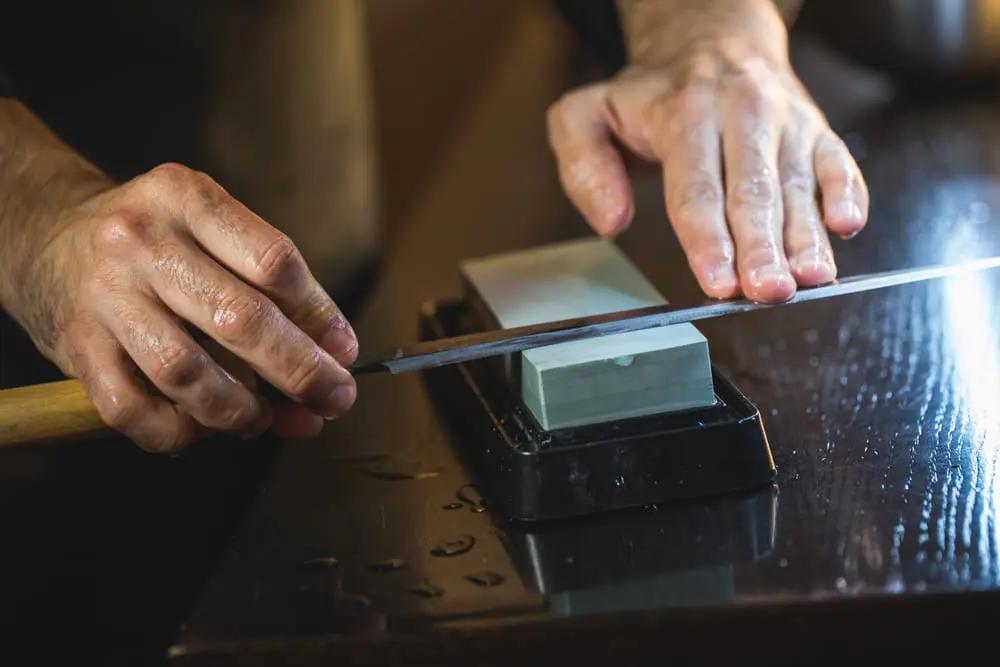
This is the most critical step. The angle between the blade and the stone must be kept constant throughout the sharpening process. The angle varies depending on the type of knife (usually between 15 and 20 degrees for European kitchen knives, and between 10 and 15 degrees for Japanese knives). One way to find the correct angle is to rest the bevel of the knife on the stone and then raise it slightly until the desired angle is reached.
2. Angle setting:
This is the most critical step. The angle between the blade and the stone must be kept constant throughout the sharpening process. The angle varies depending on the type of knife (usually between 15 and 20 degrees for European kitchen knives, and between 10 and 15 degrees for Japanese knives). One way to find the correct angle is to rest the bevel of the knife on the stone and then raise it slightly until the desired angle is reached.
3. Steps on the coarse-grained stone (if necessary).
With light, steady pressure, you run the blade across the stone, maintaining the angle: the movement should cover the entire length of the cutting edge. You make passes from one side of the blade until you feel a slight "burr" (a thin folded edge of metal) on the other side.
4. Steps on the medium-grained stone
The same process is repeated, reducing the pressure slightly. The goal is to remove the scratches left by the coarse-grained stone and continue to define the edge.
4. Steps on the medium-grained stone
The same process is repeated, reducing the pressure slightly. The goal is to remove the scratches left by the coarse-grained stone and continue to define the edge.
5. Steps on the fine-grained stone
you continue to refine the edge, further reducing the pressure. You make passes alternating sides of the blade, trying to remove the burr formed.
6. Slime removal
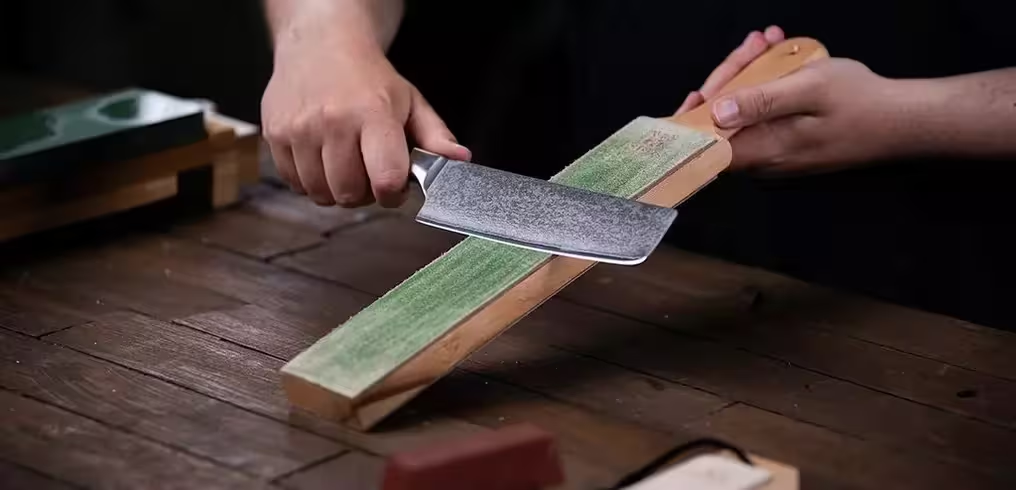
this step is crucial for obtaining a sharp edge. Different techniques can be used, such as alternating light passes on the fine-grained stone, passes on a ceramic whetstone or on a coramella (leather strip).
6. Slime removal
this step is crucial for obtaining a sharp edge. Different techniques can be used, such as alternating light passes on the fine-grained stone, passes on a ceramic whetstone or on a coramella (leather strip).
7. Polishing
Using extra-fine-grained stones or a strop with abrasive paste polishes the edge for an even more precise and smooth cut.
Sharpening blades and knives is a valuable skill that ensures optimal tool performance, safety in use, and increased durability.
This site is registered on wpml.org as a development site. Switch to a production site key to remove this banner.